
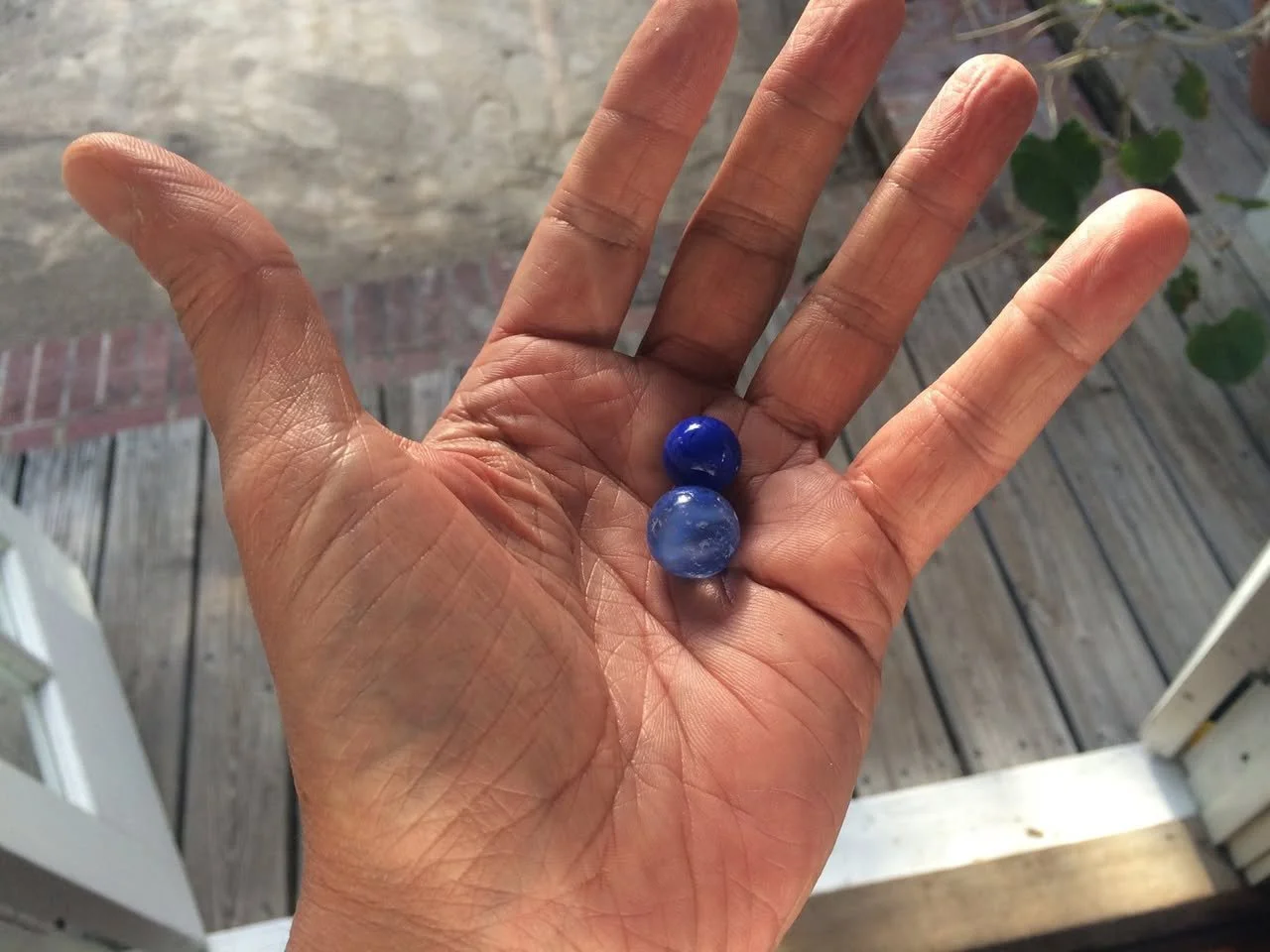
MARBLES RECOVERED!
This is about some mysterious connections across time. Many years ago a tall, woebegone poet friend and I used to go to astronomy lectures at the Natural History Museum in New York. At the gift shop there, I bought some blue marbles printed with a map of the earth, turning them into tiny, glass globes. I gave one to him. My friend happened to know and idolize the poet James Merrill. When he attended Merrill’s burial in Stonington, Connecticut, he threw the marble globe into the grave as a kind of offering. (He’d somewhat ceremoniously asked my permission first, since the marble had been my present to him.) When Sandy McClatchy wrote an appreciation of Merrill in The New Yorker, he began by mentioning my friend (anonymized as “a young poet”) throwing the marble into the grave. I was living out of the country when Merrill died.
Years and years later, I started coming to Key West with Darrell Crawford. We rented a great little house that used to belong to David Jackson, Merrill’s partner, and we eventually bought it. Merrill used to spend his winters in this house and Darrell and I started doing the same, getting to know the town’s aging literary stragglers, who had all been “Jimmy’s” friends.
But first! Years and years before any of this, before I’d even moved out of the country, and before he died (obviously), Merrill published a long poem, also in the New Yorker (March 10, 1986), a beautiful meditation on getting old addressed in part to a young poet, “Charmides”—maybe a clone of Socrates’ or Wilde’s dream boy of the same name. It became a little well-known for a poem. Title: “Losing the Marbles.”
In the poem, “losing marbles” isn’t just old people losing their faculties, it’s also what Athens did with the Parthenon frieze, viz. “The Elgin Marbles.” I remember reading the poem when it appeared. It was already rare back then to find anything written with so much historical self-consciousness. An elaborate play on papyrology, including modified Sapphics, in the New Yorker, for God’s sake! If his urbanity doesn’t make your teeth hurt, as it does mine sometimes, please read the poem! It’s wonderful.
I forgot all about the poem until our Key West neighbor, Peter, an old friend of Merrill’s who lived in Boston most of the year, came by and told me to keep my eye peeled for “the Elgin Marbles” in the back yard. At the end of the poem Merrill secretes everyday marbles out there.
As new owners, Darrell and I decided to re-lay the bricks around the pool in the back yard. I told the two guys doing the work, brothers from Mexico, named (a supernatural flourish) Hernán and Hermann, “If you find any marbles while you’re digging up the old bricks, be sure to tell me.” Hermann, the younger one, found two of them. I came running. I told him, “Hermann, this is really a big deal! For some of us, these are extremely famous marbles!” Normally too dignified to smile, he thought my absurd, milord excitement was pretty funny. Later both of them found quite a few more of the marbles.
Here’s the concluding fifth section of the poem. Langdon Hammer, in his biography of Merrill, which is great, is especially keen when he talks about the poetry, including the Sandover epic, which Merrill famously wrote/transcribed with David Jackson from a Ouija board. Hammer is sophisticated on the nagging question of what did Merrill REALLY believe when it comes to ghosts, bats, spirits, angels, V work and all the rest.
After the endless jokes, this balmy winter
Around the pool, about the missing marbles,
What was more natural than for my birthday
To get—from the friend whose kiss that morning woke me—
A pregnantly clicking pouch of targets and strikers,
Aggies and rainbows, the opaque chalk-red ones,
Clear ones with DNA-like wisps inside,
Others like polar tempests vitrified . . .
These I’ve embedded at random in the deck slats
Around the pool. (The pool!—compact, blue, dancing,
Lit-from-beneath oubliette.) By night their sparkle
Repeats the garden lights, or moon- or starlight,
Tinily underfoot, as though the very
Here and now were becoming a kind of heaven
To sit in, talking, largely mindless of
The risen, cloudy brilliances above.